


Written by the NewsMagToday Content Team | Reviewed by Deepu Thakur, Technology Enthusiast, newsmagtoday.com | Last updated: September 2026
A flashlight is a portable, battery-powered electric light, a tool so common that most people never stop to think about where it came from. Yet today’s compact, rechargeable LED lights are worlds apart from the first electric flashlight, a dim paper tube from the closing years of the 1890s.
This guide covers the full flashlight history: what a flashlight is, when and how it was invented, who is credited with it, and how it evolved from candles and lanterns into the modern LED and rechargeable models we rely on now.
What is a Flashlight?
A flashlight is a handheld electric light powered by batteries. Every flashlight, old or new, is built from the same core parts:
- A light source (an incandescent bulb in older models, an LED in modern ones),
- A power source (disposable or rechargeable batteries),
- A reflector or lens to shape and direct the light,
- A housing or body that holds everything together, and
- A switch to turn it on and off.
A flashlight is a handheld electric light powered by batteries. Every flashlight, old or new, is built from the same core parts: a light source, power source, switch, and housing. Modern flashlight brand Olight combines these basic components with newer LED technology, rechargeable batteries, and durable materials to improve brightness, runtime, and portability.
The way it works is simple. When you press the switch, you close an electrical circuit; current flows from the battery to the bulb or LED, which produces light; and the reflector and lens focus that light into a usable beam.
Because a flashlight is self-contained and needs no wall socket or open flame, it goes wherever you do. That makes it useful for everyday carry, emergencies and power outages, camping and hiking, work and inspection, automotive situations, and many outdoor activities any time you need portable light you can point where you want it.
When Was the Flashlight Invented?
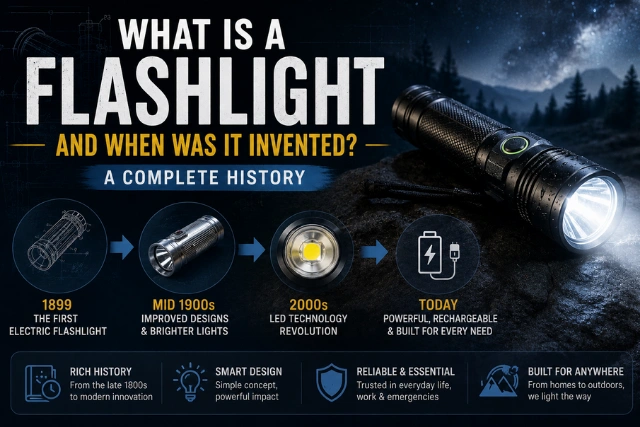
The first practical electric flashlights appeared around 1899, at the very end of the 19th century. What made them possible was the arrival of two technologies at roughly the same time: the portable dry-cell battery and the small incandescent electric bulb.
Before this, electric light meant fixed wiring and bulky power sources. The dry cell changed that by making electricity portable and safe enough to carry, while miniature bulbs gave that electricity something compact to light up. Put a battery, a bulb and a switch inside a tube, and you had the first electric flashlight. It’s worth drawing a distinction here: portable electric lighting developed gradually over several years, but the recognizable handheld flashlight came together right at the close of the 1890s.
Who Invented the Flashlight?
The inventor most closely associated with the first hand flashlight is David Misell, a British-born engineer working in New York. On January 10, 1899, Misell was granted U.S. Patent No. 617,592 for an “electric device” that was the first battery-powered flashlight. He assigned the patent rights to the American Electrical Novelty and Manufacturing Company, owned by businessman Conrad Hubert, a company that later became the American Ever Ready Company, the predecessor of Eveready.
It is more accurate to say the flashlight was the product of several developments than the work of one person overnight. Misell’s design brought together portable batteries, small incandescent bulbs, a simple electrical switch and a reflector. Each of those already existed; the invention was combining them into one practical, pocketable tool and Hubert’s role in manufacturing and selling it was just as important in making the flashlight a real product rather than a prototype.
What Did People Use Before Flashlights?
For most of history, portable light meant an open flame. The common options were candles, oil lamps, lanterns and gas lighting. They all worked, but each had real drawbacks.
Why Were These Lights Replaced by Electric Flashlights?
Flame-based lights carried risks and inconveniences that electric lighting solved:
- Fire and heat an open flame could start a fire or burn the user.
- Smoke and fumes oil and gas lights produced soot, odor and smoke.
- Limited portability, many were awkward to carry and easily blown out.
- Poor fit for many environments flames were dangerous around fuel, dust or enclosed spaces.
A flashlight replaced the flame with a sealed battery and bulb, offering cleaner, safer and more convenient light. That practical advantage is the main reason electric flashlights steadily replaced older portable lights.
The First Electric Flashlights
What set the first electric flashlight apart was obvious: no flame, no smoke, and light you could switch on instantly. But the early models had clear limits. The batteries were weak and short-lived, and the carbon-filament bulbs were inefficient, so the light was dim and didn’t last long.
These early lights were sometimes called electric torches and in British English, “torch” is still the standard word for a flashlight. Compared with today’s lights, the first flashlights were far less bright, efficient or reliable, but they were a genuine step forward from carrying a candle or a lamp.
How Did the First Flashlights Work?
The technology was straightforward, and it follows the same chain of events a modern flashlight does:
- The battery supplied electrical energy.
- The switch closed the circuit when pressed.
- Current reached the bulb.
- The bulb produced light.
- The reflector directed that light forward into a beam.
Misell’s original was essentially a paper and fiber tube holding three “D” batteries front to back, with a small bulb, a brass reflector and a rounded glass lens at one end. Simple, but effective enough to prove the concept.
There is also a clear reason behind the name. Early zinc–carbon batteries couldn’t hold a steady current and needed to rest, so the light could only be used in short bursts flashes. That is how the North American name “flashlight” came about.
How Flashlights Became Popular in the United States
Flashlights didn’t take over immediately. Early versions were too limited by weak batteries and dim bulbs to replace lamps outright. But as battery chemistry and bulb design improved through the early 1900s, flashlights became brighter, longer-lasting and far more practical.
From there, adoption spread quickly wherever safe, portable light mattered: in homes as emergency lights, among police and emergency services, in military use, across industry, and for outdoor activities. Improvements in manufacturing lowered prices and made flashlights widely available, turning them from a novelty into a standard household and professional tool across the United States.
The Evolution of the Flashlight
The history of the flashlight is essentially a story of steady improvement more light, longer runtime and better durability at each stage.
Late 1800s – The First Electric Flashlights
The earliest models paired simple dry-cell batteries with incandescent bulbs in basic handheld designs. They were dim and unreliable but established the format.
Early 1900s – Wider Adoption
Better batteries and improved designs made flashlights more dependable, and greater availability put them in more hands.
Mid-20th Century – More Durable Designs
Sturdier materials, better switches and more reliable batteries made flashlights tougher and more practical for everyday and professional use.
Late 20th Century – Halogen and High-Performance Lighting
Halogen and similar bulbs delivered brighter output, better beam performance and longer operating times, pushing flashlights into higher-performance territory.
21st Century – LED Flashlights
Light-emitting diodes replaced incandescent bulbs in most flashlights. LEDs are far more efficient and longer-lasting, and they enable higher brightness, longer runtimes and much more compact designs — the foundation of the modern flashlight.
How are Modern Flashlights Different From the First Flashlights?
The core design hasn’t changed, but almost every component has improved dramatically.
| Feature | Early Flashlights | Modern Flashlights |
| Light source | Incandescent bulb | LED |
| Power | Early dry-cell batteries | Rechargeable / lithium batteries |
| Brightness | Relatively low | Much higher |
| Runtime | Limited | Longer |
| Size | Often bulky | Compact options available |
| Durability | Basic | Impact- and water-resistant designs |
| Charging | Battery replacement | USB, magnetic and rechargeable options |
A modern rechargeable flashlight can produce more light, last far longer and survive rougher treatment than anything available in 1899.
What are Flashlights Used For Today?
The flashlight’s job hasn’t changed portable light where you need it but the range of uses has grown. Today they are relied on for everyday carry, home emergencies and power outages, camping, hiking and hunting, search and rescue, automotive emergencies, work and inspection, and tactical and professional applications. The same basic tool now spans a keychain light for finding a lock and a high-output light for a rescue team.
What Types of Flashlights Are Available Today?
Modern flashlights come in forms tailored to specific jobs:
- EDC flashlights – Compact lights for everyday carry.
- Tactical flashlights – Rugged, high-output lights with fast, simple controls.
- Headlamps – Worn on the head for hands-free work.
- Long-range (thrower) flashlights – Focused beams built for distance.
- Work lights – Wide, even light for tasks and repairs.
- Camping lanterns – Soft, all-around light for a space.
- UV flashlights – Ultraviolet light for detection and inspection.
- Keychain flashlights – Tiny lights that go everywhere.
Brands such as Olight organize their lineups along these lines EDC, tactical and headlamps among them which makes it easier to shop by the job you need done rather than by raw specs.
What Makes a Modern Flashlight Good?
If you’re choosing a light today, a handful of factors matter more than the number on the box. Lumens tell you total light output, while candela and beam distance tell you how far and how intensely that light reaches. Runtime shows how long it lasts on a given setting, and battery type — especially whether it’s rechargeable affects both convenience and running cost. Water resistance (an IPX rating) and impact resistance determine how well it survives real conditions. Size and weight decide whether you’ll actually carry it, and multiple lighting modes let you match output to the task. The best flashlight is the one that balances these factors for how you’ll use it.
The Bottom Line
The flashlight has come a long way from candles and lanterns, to David Misell’s dim electric tube in 1899, to today’s bright, compact, rechargeable LED lights. Batteries and bulbs improved, incandescent gave way to LED, and disposable cells gave way to USB and magnetic charging. Through all of it, the fundamental purpose has stayed exactly the same: providing portable light when and where you need it. Companies like Olight show how that long evolution continues, refining brightness, efficiency and durability in the flashlights we carry today.
Frequently Asked Questions
When was the first flashlight invented?
Around 1899, when David Misell received a U.S. patent for the first battery-powered flashlight.
Who invented the first flashlight?
David Misell is credited with inventing it; Conrad Hubert’s company, later Eveready, commercialized it.
What was the first flashlight powered by?
Early dry-cell zinc batteries had three “D” cells in Misell’s original design.
What did people use before flashlights?
Candles, oil lamps, lanterns and gas lighting — all open-flame sources.
How did the first flashlight work?
A battery sent current through a switch to a bulb, and a reflector directed the light forward.
When did LED flashlights become popular?
In the 2000s, efficient high-brightness LEDs replaced incandescent bulbs as the standard.
What is the difference between an old and modern flashlight?
Modern flashlights use LEDs and rechargeable batteries for far greater brightness, longer runtime and better durability than early incandescent models.